


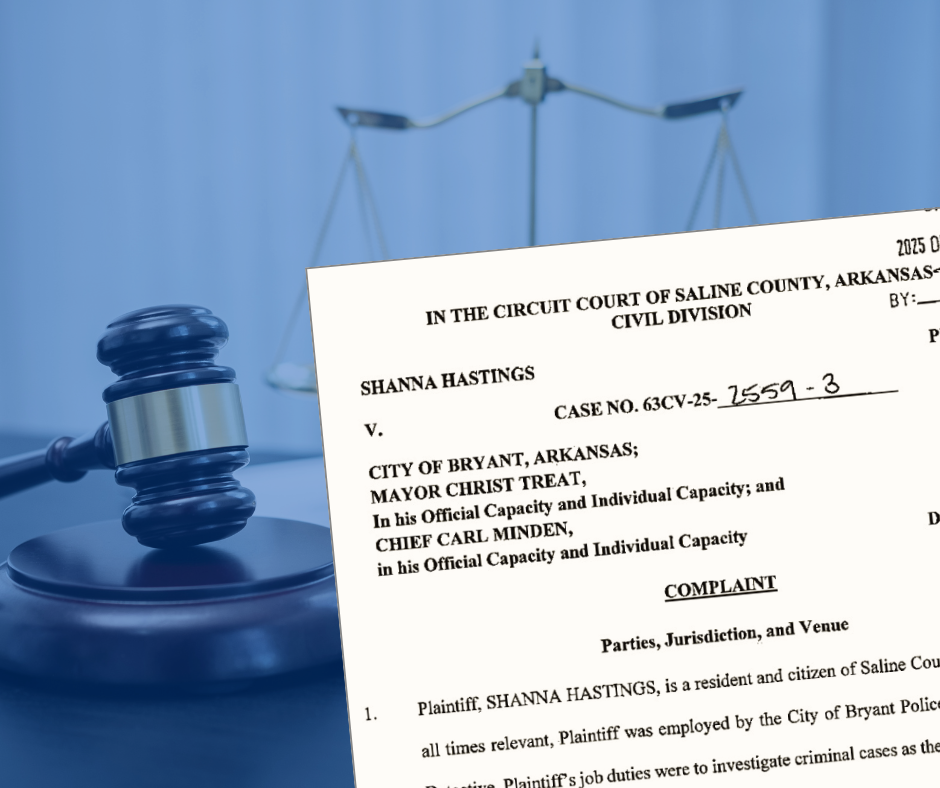
A former Bryant police detective has filed a lawsuit against the City of Bryant, Police Chief Carl Minden, and Mayor Chris Treat. The officer claims she was fired in retaliation for blowing the whistle on alleged misconduct within the police department.
Note that as of the filing date on Friday December 12, 2025, the City of Bryant and the other defendants had not yet filed their responses to the lawsuit. The allegations in the complaint represent Hastings’ side of the story; the city and officials will have the opportunity to respond in court and present their defense. The outcome of this case could have implications for the City of Bryant’s governance and could test the strength of Arkansas’s whistleblower protections for public employees.
The 24-page complaint, filed in Saline County Circuit Court, outlines a timeline of events leading up to her termination. It accuses the city’s top officials of violating Arkansas whistleblower law, as well as the officer’s constitutional rights. The lawsuit seeks damages for wrongful termination, defamation, emotional distress, and other claims. It also gives a detailed picture of the alleged conflicts that preceded her firing.
Read below for detail on the background of this case, protected disclosures, misconduct, termination, alleged retaliation, legal claims, allegations, and the justice this officer seeks.
BACKGROUND
Plaintiff Shanna Hastings is identified in the suit as a “decorated and respected CLEST-certified law enforcement officer” with over a decade of service at Bryant Police Department. Hastings rose through the ranks to become a detective in the Criminal Investigations Division by 2023, according to the complaint.
The defendants are the City of Bryant and two of its leaders – Police Chief Carl Minden and Mayor Chris Treat. Chief Minden is the city’s chief law enforcement officer and, the lawsuit states he is a key policymaker over police operations and personnel matters.
Mayor Treat, the suit says, was the final decision-maker for city employment actions. Both Minden and Treat are sued in both their official and individual capacities in connection with Hastings’ allegations.
The lawsuit states that Hastings had a strong record as an officer and that she repeatedly tried to address problems internally before turning to the courts. The suit emphasizes that all events in question took place in Saline County and under the authority of the City of Bryant’s officials.
Jurisdiction is claimed under the Arkansas Whistle-Blower Act (Ark. Code Ann. § 21-1-601 et seq.) and the Arkansas Constitution, Article 2, §§ 4, 6, and 8, which protect free speech, due process, and other civil rights.
PROTECTED DISCLOSURES AND ALLEGED MISCONDUCT
According to the complaint, Hastings engaged in protected whistleblowing activities by reporting suspected misconduct, corruption, and unlawful activity within the Bryant Police Department. The timeline of Hastings’ internal reports spans from early 2024 through the summer of 2025. Read the timeline of events below.
January 2024:
In one early incident, Hastings raised concerns about the way fellow officers were questioning witnesses during an investigation. This lawsuit claims she believed the officers’ conduct during that January 2024 interview was improper, and she reported these concerns through internal channels. This was the first time that it’s recorded that Officer Hastings offered information in a protected disclosure.
Mid-2025 Incidents:
The lawsuit details a series of events in June and July of 2025 that Hastings was either involved in or learned about, which she says she blew the whistle on.
On June 21, 2025, Hastings states she became aware that Captain Nate Johnston had allegedly ridden a motorcycle after leaving a bar in a manner that raised her concern. Hastings viewed this as a serious off-duty misconduct issue. The complaint states she reported or attempted to address this incident internally.
June 28, 2025 – Disturbance Call:
June 28, 2025, Bryant police officers responded to a disturbance at a local establishment. The lawsuit does not specify all details of the disturbance, but it implies it was a significant incident requiring follow-up. Two days later, the investigation of that disturbance case was officially assigned to Detective Hastings.
Investigation of the June 28 Incident:
The complaint suggests that Hastings’ investigative actions around on July 2, 2025, led her to suspect wrongdoing by more officers involved in the incident.
The lawsuit states that on July 4, 2025, Hastings’ immediate supervisor, Sgt. Nick Dean, informed her that Chief Minden instructed other officers not to speak with her about the case. This alleged action by Minden was interpreted to mean that he was impeding her investigation by silencing potential witnesses or collaborators within the department.
Hastings reported this internally, considering it a serious obstruction and potential evidence of a cover-up.
July 9–10, 2025 – Prosecutor Meeting and Follow-Up:
On July 9, 2025, Hastings met with Saline County Prosecuting Attorney Walton to discuss the case, according to the lawsuit. It says she was looking into adding a gang-related activity to the charges stemming from the June 28 disturbance.
The suit states that on July 10, 2025, Sgt. Dean conducted follow-up interviews with witnesses regarding the disturbance. It’s unclear if this was at Hastings’ request or part of parallel internal affairs, but it is mentioned as part of the timeline of events.
TERMINATION AND ALLEGED RETALIATION
Hastings stated she repeatedly reported her concerns up the chain of command – these were her protected disclosures. She alerted superiors to what she saw as misconduct.
That misconduct is: from the Captain’s off-duty behavior, to alleged interference of an active investigation by Chief Minden, and any other irregularities surrounding the June 28 incident.
According to the lawsuit, rather than addressing the problems Hastings pointed out, the Department’s leadership began to view her as a troublemaker for bringing them to light.
In mid-July 2025, the complaint describes a swift escalation against Hastings soon after her last whistleblowing activities:
On July 15, 2025, Hastings was herself subjected to an internal investigation. The lawsuit indicates that on that day, she was called in for what it calls a “now-designated” administrative inquiry. Hastings states she was not initially told why she was being investigated.
Hastings saw this internal investigation as a pretext to punish her. The same day, Hastings texted a colleague – identified as Lt. Courtney – expressing concern that she was being targeted in retaliation for her recent reports. This was a private text message, referenced in the suit.
On July 18, according to the suit, Sgt. Dean informed Hastings that Chief Minden had allegedly made statements about her possible termination.
On July 21, 2025, the City of Bryant terminated Shanna Hastings’ employment, according to documents. The lawsuit states this was done abruptly and without providing Hastings any prior notice of specific allegations against her.
According to the complaint, the official reasons given to Hastings at the time were accusations of violating department policies – specifically, “Standards of Conduct” Section 16 (Insubordination) and Section 17 (Failure to Follow Orders). Hastings denies these accusations and claims they were a pretext for retaliation. She argues that she was fired not for any legitimate misconduct on her part, but because she had persistently reported wrongdoing by others.
The lawsuit asserts that Hastings was never informed she was under investigation or given a chance to defend herself before being fired. She states there was no prior disciplinary hearing or clear explanation. A key part of her complaint is this alleged failure to follow standard due process for a police employee – such as notifying her of charges, allowing her to respond, or progressive discipline. Hastings asserts that the department violated its own procedures and her rights by rushing to terminate her for ulterior motives.
The complaint points out that just a few days after Hastings was fired, two other police supervisors were disciplined in relation to the same June 28 disturbance case. On July 24, 2025, those two unnamed supervisors were formally reprimanded for mishandling the incident, with officials allegedly telling them that they had “messed the case up.”
Hastings highlights this in her lawsuit to bolster her claim that she was not the one at fault for any investigative issues. If others were found to have mishandled the case, she argues, it undermines the legitimacy of firing her under the label of insubordination or poor performance. This sequence of events, in Hastings’ view, suggests that her termination was retaliatory and that she was ousted for raising issues. She further asserts that the officers whose actions she questioned received comparatively mild discipline.
The lawsuit also describes what happened in the weeks and months following Hastings’ termination. The suit states she pursued available avenues to clear her name, including a post-termination appeal hearing.
According to the complaint, an independent hearing officer eventually reviewed her firing. In lines 38 and 39 of page 8 of the complaint is states the finding:
“38. The hearing officer issued a decision stating that the employer did not demonstrate by the preponderance of the evidence that Plaintiff violated the directive regarding discussing the case and found that the Plaintiff was discharged from her job for reasons other than misconduct in connection with her job.
39. On or about September 24, 2025, Plaintiff was advised via a letter from the Division of Law Enforcement Standards and Training that the Commission did not find reasonable basis to proceed to a hearing and therefore, Plaintiff was still eligible to serve as a law enforcement officer in the State of Arkansas.”
The lawsuit suggests the hearing officer found issues with how the termination was carried out or with the severity of the punishment. Despite this, the City of Bryant allegedly stood by the firing, as well as initiated proceedings to revoke Hastings’ law enforcement certification.
The complaint notes that in late 2025, the Department filed a request with the Arkansas Commission on Law Enforcement Standards and Training (CLEST) to decertify Shanna Hastings as an officer. Being decertified by CLEST would prevent Hastings from serving in law enforcement anywhere in Arkansas. Hastings calls this move additional retaliation, aimed at ruining her career prospects in policing because she spoke out.
Finally, the lawsuit alleges that Bryant officials made public statements about Hastings’ termination that damaged her reputation. The complaint does not quote those statements verbatim, but it asserts that the city falsely portrayed Hastings as an insubordinate officer deserving of dismissal.
Hastings claims these statements were defamatory and were made in bad faith to cover up the true reason for her firing. She says her professional reputation and personal standing in the community have suffered as a result.
LEGAL CLAIMS AND ALLEGATIONS
Hastings’ lawsuit brings a wide array of legal claims against the city, the police chief, and the mayor. The causes of action outlined in the complaint include:
Violation of the Arkansas Whistle-Blower Act:
Hastings asserts that her reports of misconduct were protected activities under state law, and that firing her for those reports violates Ark. Code Ann. § 21-1-601 et seq. (the Arkansas Whistle-Blower Act). This law prohibits public employers from retaliating against employees who disclose wrongdoing.
Free Speech Retaliation:
The suit cites Article 2, Section 4 of the Arkansas Constitution (and parallel protections) regarding freedom of speech. Hastings contends that by punishing her for speaking out on matters of public concern (alleged police misconduct), the defendants violated her right to free expression. She alleges she was silenced and removed for exercising her freedom to speak up about official wrongdoing.
Denial of Due Process:
Citing Article 2, Section 8 of the state constitution, Hastings claims she was deprived of her liberty and property interests in her job without due process. Because she was a longtime employee, she argues she had a reasonable expectation of fair procedure before being terminated. The abrupt firing – with no notice or chance to respond – allegedly fell short of constitutional standards and the city’s own policies.
Defamation:
Hastings accuses the defendants of making false and defamatory statements about her, particularly in relation to the reasons for her termination. The complaint suggests that official comments (potentially by the Chief or Mayor) cast her in a negative light and were untrue. Hastings claims these statements have harmed her reputation and good name.
Intentional Infliction of Emotional Distress (Outrage):
The lawsuit describes the defendants’ conduct as extreme and outrageous, done willfully to cause harm. Hastings says being unjustly branded as a bad officer, fired, and having her career destroyed was emotionally devastating. She seeks damages for the severe distress, humiliation, and anguish this ordeal has caused her.
Civil Conspiracy:
Hastings alleges that Chief Minden and Mayor Treat acted in concert to retaliate against her. The complaint accuses them of civil conspiracy, meaning they supposedly agreed and coordinated to take unlawful actions (retaliatory firing, defaming her, etc.) to punish Hastings for her whistleblowing. By presenting a united front in removing her, and then justifying it with false pretenses, the two officials are alleged to have conspired to violate her rights.
In addition to these claims, the lawsuit notes that all the actions by Minden and Treat were done “under color of state law” – a phrase indicating that they were acting in their official capacity. This language often underpins a federal civil rights claim (42 U.S.C. § 1983), suggesting Hastings may also be pursuing relief for violation of her First Amendment and Fourteenth Amendment rights in federal terms. However, the complaint as filed centers on Arkansas state law and constitutional provisions, seeking to hold the city and its officials accountable under state whistleblower protections and civil rights guarantees.
SEEKING JUSTICE
Shanna Hastings is asking the court for relief that would make her “whole” after what she describes as a wrongful, retaliatory termination. In her lawsuit, she requests compensatory damages for lost wages and benefits, damage to her reputation, and the emotional pain and suffering she has endured.
She also seeks punitive damages against the individual defendants (Chief Minden and Mayor Treat) to punish and deter what she calls malicious conduct. Additionally, Hastings wants her legal fees covered and any other appropriate relief the court deems just.
The lawsuit does not explicitly state whether Hastings seeks reinstatement to the police force, but the broad language suggests she is open to any remedy that corrects the situation. At minimum, she is aiming to clear her name and recover the career and standing she lost. The complaint demands a jury trial, indicating that Hastings wants a public hearing of the evidence and allegations.
According to the court docket, the case (No. 63CV-25-2554) has been assigned to Saline County Circuit Judge Brent Houston. Hastings is represented by Mathew Robert Ingle. The lawsuit puts a spotlight on the challenges whistleblowers can face within law enforcement agencies, and it will proceed through the Arkansas legal system in the coming months.
Shanna Hastings vs Bryant, Treat, Minden 121225.pdf by Shelli Poole