

How the Ball Bounces with Bekka: If It Helps Us Win, Point Me Toward the Wall
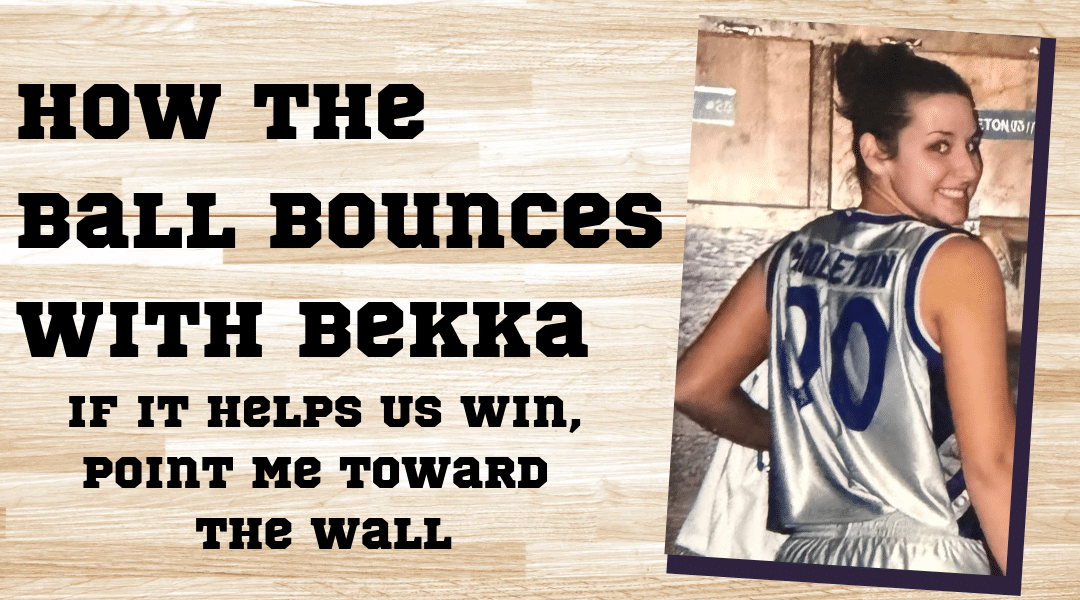
I once had a coach make an observation about me that was probably intended to be funny, or at the very least truth veiled in humor. He said he believed that if he told me banging my head against a wall would help us win a basketball game, I’d pick a spot and start banging.
He wasn’t wrong.
In fact, depending on how important the game was, I probably would’ve asked him how many times and whether he wanted me to use the same spot.
Listen. I like to win.
Always have. And probably always will.
And when I was playing competitive basketball, if somebody I trusted told me that making a change would improve my game or help my team win, I was all in.
Tweak my shooting form? Let’s do it.
Adjust my defensive stance? On it.
Run the same drill seventeen more times because I’m not getting it right? I’ll run…but don’t listen too close to the mumbles under my breath as I pass by. Not for the faint of heart.
I did these things because I wanted to get better and because I wanted to win. Preferably both, but if I’m being completely transparent, winning was pretty high on the priority list.
Now, here’s where things get interesting.
I played with some incredibly talented athletes over the years. Girls who could shoot, defend, rebound, and do things on a basketball court that made the rest of us look downright ordinary. But some of those same girls had a remarkable ability to turn the simplest coaching correction into a full-blown personal crisis. Cue the drama!
A coach would suggest changing their footwork and you’d think he’d asked them to donate a kidney.
A coach would point out something they were doing wrong defensively, and here came the eye rolls…the sighs…the dramatic expressions…the general gnashing of teeth.
And I’m standing there thinking, WHAT ARE WE DOING? This person is literally paid to help us become better basketball players. That’s the job. That’s why we have a coach. For Pete’s sake!
Now, I understand that nobody particularly enjoys being told they’re doing something wrong. Especially when they’ve spent years working hard to become good at something. But there’s a difference between being good at something and being the best you can be. And sometimes the only thing standing between those two versions of yourself is your willingness to listen.
The funny thing about those teammates is that, more often than not, they eventually came around.
After the complaining. After the arguing. After spending a perfectly ridiculous amount of time trying to prove they didn’t need to change anything. And after the wasted steps of our lives spent running line drills based on noncompliance…they’d finally try what the coach had suggested in the first place.
And wouldn’t you know it? It worked.
Suddenly the move was easier. The shot was better. The defensive assignment made more sense.
Who’d have thunk it???
The person who spent their days studying basketball and figuring out how to make us better might actually have known what they were talking about.
Amazing.
And while I might have enjoyed a tiny moment of personal satisfaction watching that realization unfold, the truth is that their improvement made all of us better. Because that’s the thing about being on a team. Your willingness to improve doesn’t just affect you. It affects everybody counting on you.
Now, before somebody accuses me of suggesting that athletes should blindly follow every instruction they’re given, let me clarify something.
Coaches aren’t infallible. They make mistakes. They have different philosophies. Sometimes an adjustment doesn’t work for a particular player. And there’s absolutely nothing wrong with asking questions.
Nobody’s suggesting completely blind allegiance here.
In fact, I think asking WHY can be one of the smartest things an athlete does.
But asking a question because you want to understand something is a whole lot different from questioning something because you don’t want to hear it. One is curiosity, the other is ego. And ego can be a pretty expensive thing to carry around when you’re trying to get better.
Funny thing about getting older. You start realizing that being coachable isn’t quite as simple as doing whatever somebody with a whistle tells you to do.
READ MORE BELOW
I had a conversation recently after a difference of opinion in the workplace. Somebody made the observation that they didn’t like being told what to do. Well, DUH. Does anybody?
I mean, I don’t particularly enjoy being ordered around either. But I don’t think that’s the same thing as being unwilling to take direction.
I was coachable at sixteen, and I’d like to think I’m still coachable today.
But here’s something I’ve learned along the way. Timing matters. Tone matters. Delivery matters. You can be absolutely right about what needs to change and still be completely wrong about how you communicate it. And before somebody tells me that taking direction at work is different from taking instruction from a coach, let me stop you right there. The settings may be different, but the principle is the same. How you deliver the message matters just as much as what you’re trying to say.
And sometimes the difference between someone hearing your advice and immediately putting up their defenses has nothing to do with the advice itself. It’s how you made them feel when you gave it. Which makes me wonder whether some of those teammates I thought were being so ridiculous might have had a point every now and then.
Don’t get me wrong. Some of them were just being stubborn. I was there. I saw the eye rolls. LOL. And maybe, occasionally, that someone was me. But I digress…
Maybe being coachable is only half the equation. The other half is knowing how to coach. Or lead. Or manage. Or whatever title happens to come with the responsibility of helping somebody else get better.
You don’t have to agree with every suggestion. You don’t have to abandon your own judgment. And you certainly don’t have to bang your head against a wall just because somebody says it’ll help.
Although, apparently, I might have considered it.
But you do have to be willing to entertain the possibility that somebody else knows something you don’t. And sometimes, the smartest thing you can do is set your pride aside long enough to find out.
Because the goal isn’t to prove you were right all along. The goal is to get better.
And if getting better helps us win? Well.
Just point me toward the wall.
And that’s how the ball really bounces.
Read more from How the Ball Bounces with Bekka in the archives at www.mysaline.com/bounces.
 About the author: Bekka Wilkerson is a lifelong lover of all things sports. Raised in a super athletic household it was no surprise when she too began to love sports at a young age. It seems like from the time she could walk she had a softball bat in her hands, but her true athletic passion came from all things Basketball. That love served her well as a Bryant High School Lady Hornet and ultimately earned her a full scholarship to play at the University of Central Arkansas – among many other adventures.
These days Bekka can be found running around Saline County with her husband, Speedy, or chasing one of her grandsons. She is also the Executive Director of The EMpact One Foundation, a Saline County Nonprofit Organization that helps young people stay connected to extracurricular activities through tuition assistance and equipment provisions.
Reach out to Bekka with questions and/or ideas about things you want to see in this column at [email protected] and learn more about The EMpact One Foundation at www.empactone.org.