


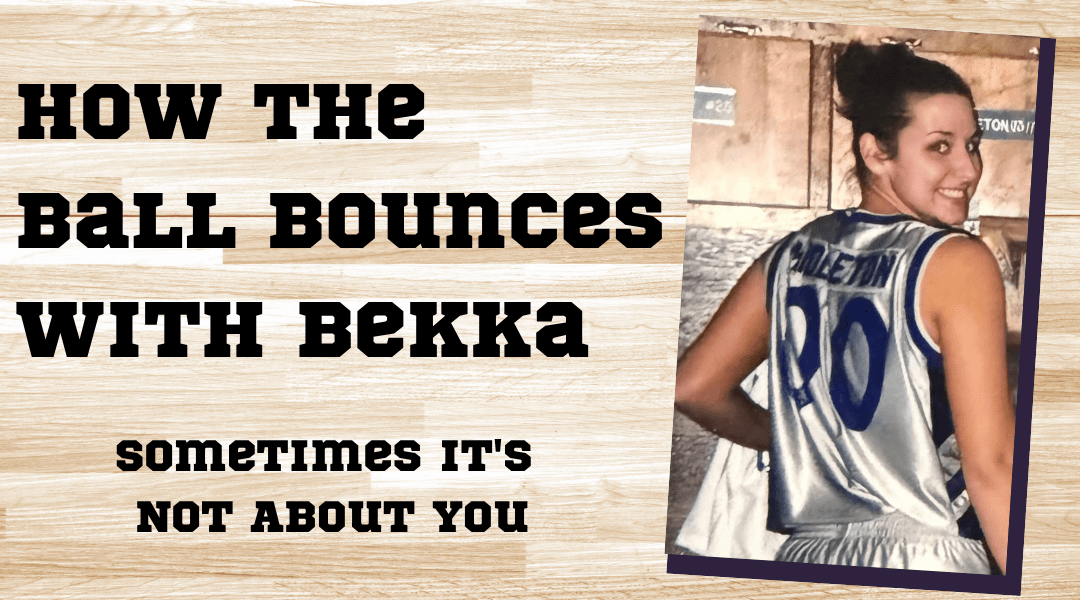
How the Ball Bounces with Bekka: Sometimes It’s Not About You
I heard Emmitt Smith say something Monday that I haven’t been able to quit thinking about. And considering the man is the NFL’s all-time leading rusher, a three-time Super Bowl champion and a Hall of Famer, there were plenty of things he said at the Little Rock Touchdown Club that probably deserved some thought.
But this one was five words.
Sometimes it’s not about you.
Smith was telling a story about his rookie season with the Dallas Cowboys and legendary coach Jimmy Johnson. During a situational drill at practice, Smith picked up the first down. Except Johnson apparently decided he didn’t. He reset the ball.
Now, I’m going to go out on a limb here and say that Emmitt Smith probably knew whether he’d gained enough yards for a first down. And I’m also going to assume Rookie Emmitt wasn’t particularly thrilled with Jimmy Johnson’s creative interpretation of where the football belonged.
But Johnson later explained that what he’d done wasn’t really about that play. And it wasn’t entirely about Emmitt. There were bigger lessons being taught. Coach Johnson plainly explained to Smith that the entire exchange was really twofold: making sure that Emmitt knew when Coach said get in the huddle, he got his hind quarters in the huddle. But it was also a clear message to the other players on the field: if Johnson would come down hard on his star rookie, nobody was exempt. There were no exceptions when it came to coaching.
“Sometimes, it’s not about you,” Smith said.
And just like that, I wasn’t sitting at the Little Rock Touchdown Club anymore.
I was back in a Bryant Lady Hornets gym…and I was mad at Carla Crowder. Like teenage-girl-who-is-absolutely-certain-her-coach-has-lost-her-ever-loving-mind mad.
I’d just played a particularly good game. Actually, let’s not practice false humility here. I’d played a GREAT game. The truth is, I don’t remember who our opponent was or what my actual stats were but I remember walking into school that day on cloud nine after a big win. Heck, my picture was probably on the front of the sports page that day. But it was all for nothing when I stepped on the court at practice.
This part I remember with crystal clarity. As soon as I took my first step on the court Coach Crowder was mad. I barely even spoke to her when she told me to take a lap – and keep taking them. Now, me being me, I definitely had something snarky to say, and that only fueled the fire. She told me I could go ahead and add the bleachers to my laps. And that’s how I spent the practice. Mad, running laps, and plotting her demise.
While the rest of the team went through the normal post game-day routine and corrective actions, shot free throws, ran drills, yada yada yada, I stared at those same four walls as I ran in circles.
Laps.
Bleachers.
More laps.
More bleachers.
I don’t remember exactly what I thought Coach Crowder was trying to accomplish that day.
Actually, that’s a lie. I’m fairly certain I thought she was trying to kill me.
What I definitely didn’t understand was why.
I’d played well. Wasn’t that the whole idea?
You play a great game, help your team, do what you’ve been coached to do—and your reward is running bleachers until you’re pretty sure your legs are going to detach from your body?
Teenage Bekka did not appreciate the lesson. Adult Bekka does. Because all these years later, I can finally see that Coach Crowder was coaching two different audiences that day.
She was coaching me.
And she was coaching everybody watching me.
My lesson was pretty simple.
Don’t get too big for your britches. One great game doesn’t make you bigger than the team. It doesn’t buy you immunity. It doesn’t mean the fundamentals suddenly don’t apply to you. And apparently it definitely doesn’t mean you’re too important to run laps.
But my teammates were getting a lesson too.
Because if the girl who’d just had a great game could be sent to the bleachers…So could anybody. Nobody was above accountability. Nobody was more important than the team. Nobody earned a permanent pass because of what they’d done the night before.
Same lesson. Different delivery. And everybody in that gym got what they needed from it.
I just happened to be the one running.
That’s the part I couldn’t understand then.
**It was about me. **But it wasn’t only about me.
And maybe that’s one of the things great coaches understand long before their players do. Sometimes they aren’t simply coaching the athlete standing in front of them. They’re coaching the room.
The best players often get coached the hardest for that very reason.
Everybody is watching.
How does she respond when Coach gets on her?
Does he pout?
Does she argue?
Does he decide he’s above the drill?
Does she keep running?
Because whether we realize it or not, sometimes our response becomes part of somebody else’s lesson. That’s a heavy thing to understand when you’re sixteen or seventeen years old. Especially when you’re on approximately Bleacher Number 4,732 and actively plotting which bottomless pit you’re going to drop your coach in.
But there’s another side to hard coaching that I didn’t understand until I was much older either. Sometimes coaches see things in us that we can’t see in ourselves yet.
They know who can carry more.
Who can be pushed farther.
Who has influence in the room.
Who everybody else is watching.
Who might become a leader before that kid has the slightest idea they’re becoming one.
And I think sometimes we mistake higher expectations for criticism.
Why is she always on me?
Why does he expect more from me?
Why can’t somebody else do it?
Why me?
READ MORE BELOW
Maybe sometimes the answer is: Because you can.
That’s not an excuse for cruelty. And I think that’s an important distinction. Hard coaching and bad coaching aren’t automatically the same thing, and neither are hard coaching and good coaching.
But the best coaches I’ve known weren’t hard simply for the sake of being hard. I, for example, am a player who needs to be coached that way. Back then, I needed the pressure of expectation from my coaches and teammates. I needed somebody expecting more from me because it made me expect more from myself.
I can still see it now, even playing at a much different level. Half the time I’m on the court by myself and I’m still coaching myself the same way.
Apparently Coach Crowder lives rent-free in my head.
But that expectation followed me off the court too. Somewhere along the way, being pushed to do more became expecting more from myself—in just about every part of my life.
There was purpose behind it.
Sometimes I recognized that purpose immediately.
Sometimes it took me thirty years.
Turns out coaches are annoyingly patient that way.
But I think the bigger lesson Emmitt Smith reminded me of Monday has very little to do with football or basketball. Because adulthood gives us approximately seventeen opportunities before breakfast to make everything about ourselves.
Somebody is short with us…What did I do?
Someone doesn’t respond…Are they mad at me?
A decision gets made we don’t understand…Why wasn’t I considered?
We’re given more responsibility…Why am I always the one who has to do it?
We’re corrected…Why are they picking on me?
And sometimes those questions are legitimate. Sometimes something absolutely is about us, and part of growing up is having enough self-awareness to recognize that too.
But sometimes? It simply isn’t.
Sometimes another person’s bad mood began six hours before you walked into the room. Sometimes a decision involves things you know nothing about. Sometimes you’re carrying more because somebody believes you’re capable of carrying it. Sometimes you’re being pushed because somebody can see a version of you that you haven’t met yet. And sometimes you’re the one running the bleachers because everybody else needs to see that you’re willing to run them.
That’s a tough concept when you’re young.
It’s not particularly easy when you’re grown either.
We naturally experience life as if we are the center of the universe. Of course we do.
But maybe maturity is learning that we don’t have to be the center of every lesson we’re standing in the middle of. Sometimes we’re the student. Sometimes we’re the example. Sometimes we’re both.
I thought Coach Crowder was teaching me a lesson that day.
She was.
It just took me a few decades to realize how many other people she was teaching at the same time.
Emmitt Smith needed one sentence to bring me all the way back to those bleachers.
Sometimes it’s not about you.
I wish Teenage Bekka had understood that.
Then again…She probably wouldn’t have listened.
She had laps to run.
And that’s how the ball really bounces.
Read more from How the Ball Bounces with Bekka in the archives at www.mysaline.com/bounces.
 About the author: Bekka Wilkerson is a lifelong lover of all things sports. Raised in a super athletic household it was no surprise when she too began to love sports at a young age. It seems like from the time she could walk she had a softball bat in her hands, but her true athletic passion came from all things Basketball. That love served her well as a Bryant High School Lady Hornet and ultimately earned her a full scholarship to play at the University of Central Arkansas – among many other adventures.
These days Bekka can be found running around Saline County with her husband, Speedy, or chasing one of her grandsons. She is also the Executive Director of The EMpact One Foundation, a Saline County Nonprofit Organization that helps young people stay connected to extracurricular activities through tuition assistance and equipment provisions.
Reach out to Bekka with questions and/or ideas about things you want to see in this column at [email protected] and learn more about The EMpact One Foundation at www.empactone.org.