

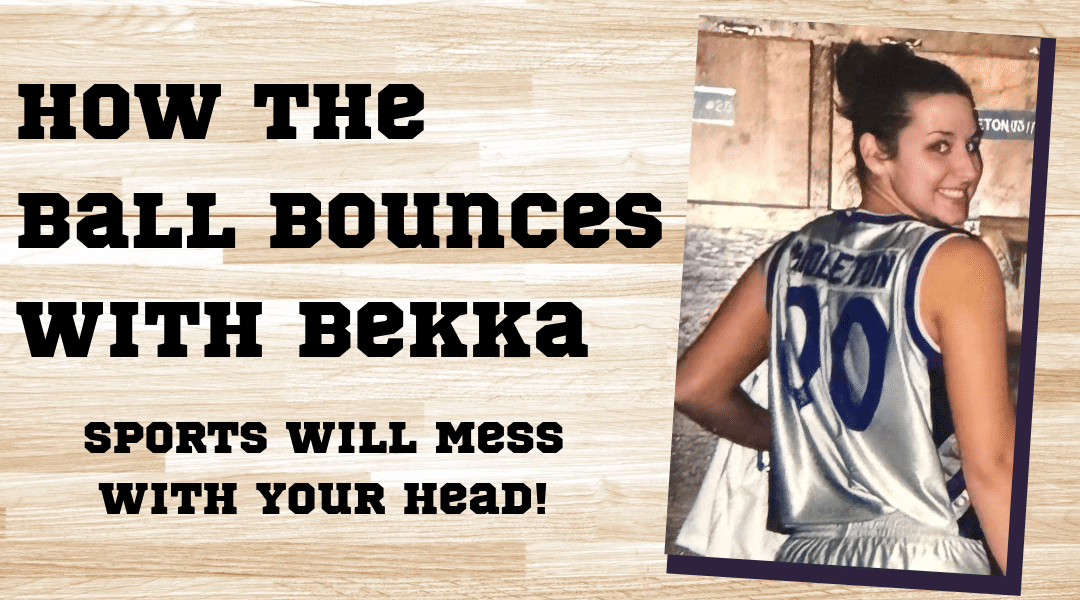
How the Ball Bounces with Bekka: Sports Will Mess With Your Head!
There are few things in this world more humbling than being absolutely, positively, 100% certain you’re ready for something.
And then finding out you’re not.
Welcome to sports, y’all.
I’ve had weeks of basketball practice where I was convinced I could do no wrong. Every move was sharp. Every pass was on target. Every free throw was a swish. I was in the zone. I was feeling it.
I was basically unstoppable.
And then came game day.
Suddenly, I couldn’t throw it in the lake and get it wet.
I’m talking about shots that had absolutely no business missing. Shots I’d made a thousand times. Shots I could probably make with my eyes closed.
Well, apparently not that day.
And here’s where things get really interesting. The first miss? No big deal. Everybody misses. The second miss? Okay, maybe I rushed that one. The third miss? Hmmm. Something’s not right. By the fourth miss, I’m questioning my shooting mechanics, my foot placement, the alignment of the planets, and whether I should have just stuck with softball.
And now I’ve got a problem.
Because instead of playing basketball, I’m thinking about playing basketball.
Nothing good ever comes from that.
Ever.
When you’ve practiced something thousands of times, your body knows what to do. You don’t have to consciously think about every little movement. You just do it.
Until you don’t.
And then your big brain, being the helpful little troublemaker that it is, decides to get involved. Maybe your elbow isn’t in the right place. Maybe your feet are too close together. Maybe you’re releasing the ball too early. Maybe you’re holding it too long. Maybe you should just pass the ball to somebody else, go sit in the stands, and rethink all your life choices.
GOOD GRIEF.
And the worst part? The harder you try to fix it, the worse it can get.
I’ve watched this happen to athletes at every level.
A baseball player who suddenly can’t hit a pitch he’d normally send into the next county. A golfer who starts questioning a swing that worked perfectly fine yesterday. A basketball player who can make twenty consecutive free throws in an empty gym but can’t buy a basket when there’s a crowd watching.
And let’s not even get started on what happens when somebody tells you to RELAX.
Oh, thank you! Why didn’t I think of that?
I’ll just relax while the scoreboard is staring at me, my coach is pacing the sideline, and approximately 400 people are watching me forget how to do the one thing I’ve spent years practicing.
Excellent advice. Why don’t you tackle world peace next, friend? LOL.
But somewhere along the way, my teammates and I figured out a little trick. Sometimes the best way to get your head back in the game is to get your mind off the game for a minute.
I can remember times when one of us would step to the free-throw line, miss the first of two shots, and immediately start that familiar mental spiral. So we’d gather before the next shot. And somebody would say something. Usually something completely off-color, wildly inappropriate, and absolutely not suitable for repeating in a family newspaper.
And we’d laugh.
Not a polite little chuckle, either. The kind of laugh that makes you forget, just for a second, that you’re standing in the middle of a basketball game with everybody watching. Then we’d break the huddle, step back to the line, and sink the second free throw.
Same basket. Same ball. Same shooting mechanics.
Different headspace.
Now, I’m not suggesting that inappropriate jokes are the secret to athletic excellence. Although, based on some of my personal experiences, I’m also not not saying that.
But there’s something to be said for breaking the cycle of overthinking.
READ MORE BELOW
The mental side of sports is a funny thing. We spend countless hours working on the physical part. We run drills. We lift weights. We practice fundamentals until we could practically do them in our sleep.
But there’s another opponent out there that doesn’t wear a jersey. And sometimes that opponent is living right between our ears.
Confidence is a strange animal. When you’ve got it, you feel ten feet tall and bulletproof. You don’t hesitate. You don’t second-guess. You just play. But lose a little of it, and suddenly everything feels harder. The basket looks smaller. The defenders look bigger. The clock seems to move faster.
And the same shot you couldn’t wait to take yesterday becomes the one you’re praying somebody else will take today.
I’d love to tell you that after a lifetime of competitive sports, I’ve mastered the art of getting out of my own head.
I have not.
Not even close.
In fact, I’ve managed to carry this particular talent right into adulthood.
These days, it usually happens when I’m working on a project or chasing a goal. I get so focused on what I’m trying to accomplish that I can’t see anything else. I call it being “in the weeds.”
I think about it. I rethink it. I analyze it. I overanalyze it. I come up with seventeen different ways to approach it, decide none of them are right, and then start the whole process over again.
Sound familiar?
And just like those missed shots, the harder I try to force a solution, the further away it seems to get. Fortunately, I married a man who is apparently always available to provide a completely unnecessary distraction.
Speedy has a remarkable ability to interrupt my mental gymnastics with some form of craziness that has absolutely nothing to do with whatever I’m stressing over.
And sometimes that’s exactly what I need.
I step away. I laugh. I get distracted by whatever ridiculousness he’s managed to introduce into my day. And when I finally come back to the project, I can usually see what I couldn’t see before.
Same problem. Same goal. Same brain.
Different headspace.
Apparently, somewhere along the way, I traded my basketball teammates for a husband who has made it his life’s mission to keep me distracted with ridiculousness.
And I wouldn’t have it any other way.
Now, I wish I could wrap this up with some profound wisdom about conquering the mental side of sports and life. Something about perseverance, positive thinking, and always believing in yourself.
But here’s the thing.
I didn’t have all the answers back then, and I sure as heck don’t have them now.
Sometimes I still get stuck. Sometimes I still overthink things. Sometimes I know perfectly well that I need to step away and can’t seem to make myself do it. And sometimes, despite all the practice, preparation, experience, and questionable humor in the world, the ball just doesn’t go in.
Some problems just stay problems.
That’s the best advice I can offer.
You’re welcome.
But I have learned that one bad shot doesn’t have to become five. One frustrating day doesn’t have to become a frustrating week. And sometimes the best thing you can do when you’re stuck is stop trying so hard to get unstuck.
Take a minute. Find something to laugh about. Let your brain do something besides wrestle with the same problem. Then come back and give it another shot.
Because the game doesn’t stop just because you missed. The ball comes back around. And when it does, maybe you’ll be ready. Or maybe you’ll still be trying to throw it in the lake.
Either way, at least you’ll have something to laugh about.
And that’s how the ball really bounces.
Read more from How the Ball Bounces with Bekka in the archives at www.mysaline.com/bounces.
 About the author: Bekka Wilkerson is a lifelong lover of all things sports. Raised in a super athletic household it was no surprise when she too began to love sports at a young age. It seems like from the time she could walk she had a softball bat in her hands, but her true athletic passion came from all things Basketball. That love served her well as a Bryant High School Lady Hornet and ultimately earned her a full scholarship to play at the University of Central Arkansas – among many other adventures.
These days Bekka can be found running around Saline County with her husband, Speedy, or chasing one of her grandsons. She is also the Executive Director of The EMpact One Foundation, a Saline County Nonprofit Organization that helps young people stay connected to extracurricular activities through tuition assistance and equipment provisions.
Reach out to Bekka with questions and/or ideas about things you want to see in this column at [email protected] and learn more about The EMpact One Foundation at www.empactone.org.